Monday, November 15, 2021

World traveller

Meet this world traveller. There may be less travel occurring from a human perspective at present, but this parcel nearly made up for it single-handedly.

Quite often the tracking for a package is pretty basic and unedifying. You know, departed country A, in transit for weeks (or months) and then suddenly turns up. Not so with this little fella. The tracking made for great ‘entertainment' in its own right.

It was an order that I made with Michael at 1/72 Legions in Plastic Depot. It left him on 27th August, and departed the U.S. on the 31st August. From there it travelled to Dubai, as you do when going US to Australia, arriving there on 1st October. After a whirlwind tour of some of the sites of antiquity (the figures are ancients) it headed to Sydney, arriving 10th of October. Leaving Sydney the next day, it headed over to here in the west of Australia, but was not processed until 7th November. Then, it finally traversed the hundred kilometres or so to arrive here late on Friday afternoon for me to collect today.

Boy, did it have some tales to tell.

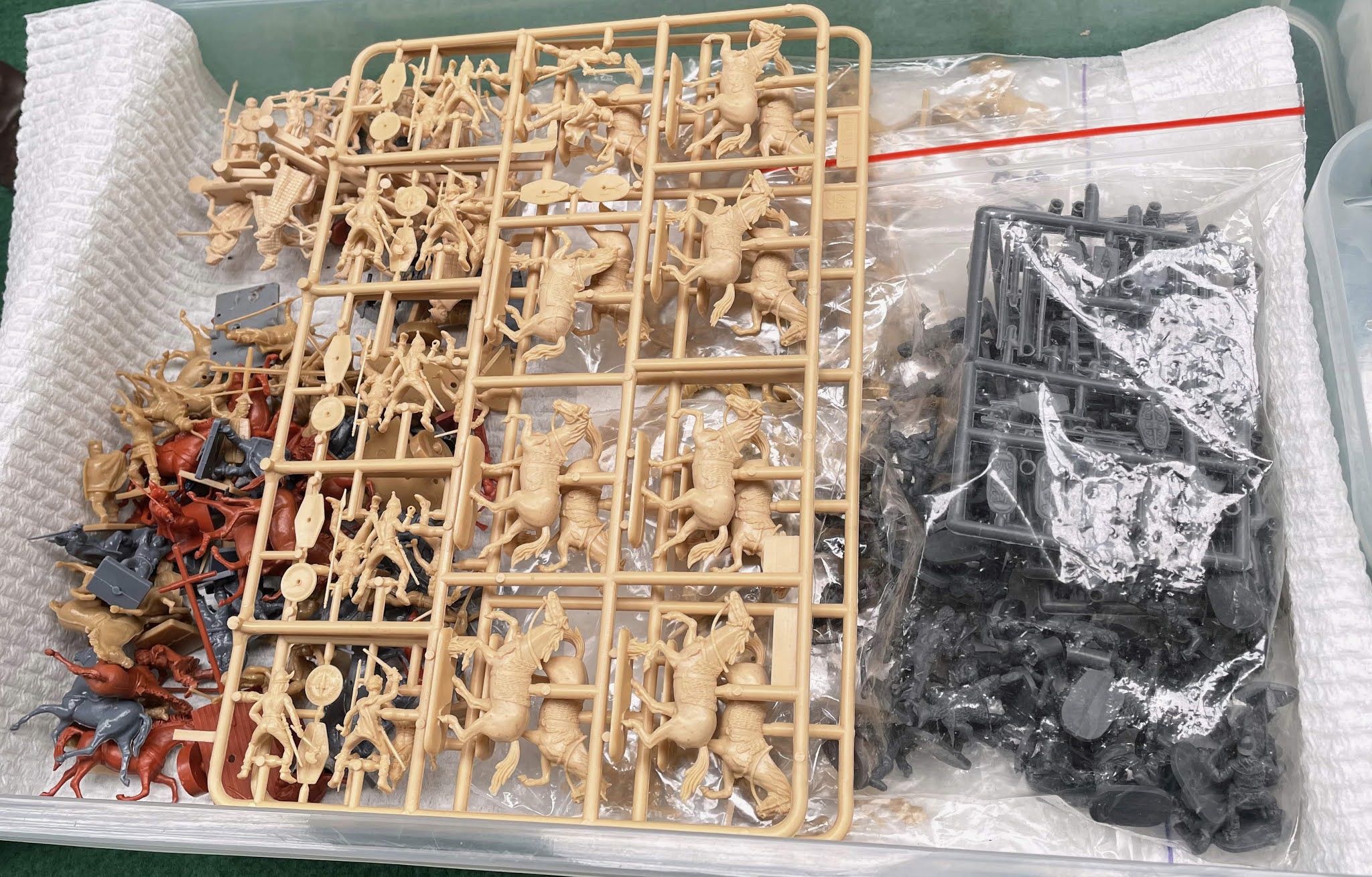
I had ordered a box of Caesar's Egyptian Chariot and Ykreol Dead German warriors, both of which are a bit rare as well as a 'Custom Blend' of Michael's. This one was called 'Roman Republic Army Battle Set' and is a wonderful mix of brands and types of figures, predominantly Republican Romans, but few related types too. There was a Carthaginian, a Trojan, a couple of Greeks, some Airfix Romans (Imperial) as well as a sprue based on the Airfix figures from Barcelona Universal Models (you can make the acronym—Francisco has a good sense of humour) which includes a one-horse version of the chariot and some other slight variations.


The main contents: a custom blend from 1/72 Legions in Plastic Depot

Looking inside.

The 'custom blend' laid out as presented on Michael's website.

Two real bonuses in this blend: a sprue from Barcelona Universal Models based on Airfix Romans, ...
and an unknown, Roman chariot driver/rider presumably from a toy soldier set of pirate figures.

I always enjoy a mixed lot of figures and this was no exception. All going well, I'll make good progress with my current painting and then will be ready to make some serious in-roads into my ancients early next year so as to try out 'Lost Battles'.

Saturday, November 6, 2021

Battle of Klissow (Klezow) in the Twilight

You remember last time... I had become busy applying basing and painting troops for the Great Northern War; outside my supposed 'focus' for the year. This extended to doing some preparation and conversions to have some pancerni cossack cavalry available too. As ever, ambition exceeds time available, but I had them 'good enough' for a game when Julian came around for a few hours last evening.

Schulenburg's Saxon army in their defensive position. These are the most nearly complete of the troops on the table.

Klessow, fought in the summer of 1702 on 8th July by Julian calendar, 9th July by Swedish calendar and 19th July by Gregorian calendar, was the third in a string of against the odds victories by the Swedes, lead by their young king Charles (Karl) XII, in the first two years of the Great Northern War. Karl an audacious commander with a fine coup d'oeil, was proving to be far more of a challenge for his enemies than they had expected when they sought to take Sweden down a peg or two upon the ascension of this little-known, until then flippant, even 'playboy' youngster to the crown. Moments maketh the man and he had more than risen to the challenge...

As with all great victories of history, the 'challenge', in a wargaming sense, is to emulate it.

The game, using "Twilight of the Sun King", provides plenty of bonuses for the Swedes (quality of troops and command), against the strengths of numbers and position of their Saxon and Polish-Lithuanian opponents. The latter are no easy beats, with mainly average troops, but also some top quality and poorer, but overall more 'flaky' morale.

For this game I used the version in the second book of scenarios for "Twilight of the Sun King". We used the 'early start' option from the scenario, so the Saxons and Swedes were in place while the Polish-Lithuanian army arrived on the Saxon/Polish-Lithuanian first turn.

View of same from Saxon lines.

Charles ordered the centre to advance, supported by Rehnskiöld's cavalry on the right, while the left-flank cavalry faced off the Saxons.

The Saxon artillery fired on the advancing Swedes, focussing on the Livgardet till Fot (heavily disguised as the Jönköping regiment), but failed to affect either morale or to stymie the advance.

The turn before the Swedish successfully negotiated the swampy banks of the stream, making a GåPå charge against the Saxon first line (guards and Kurprinz/Koningen regiments)—I thought that I had taken the photo, but obviously did not in my excitement.
Note in the top-right of photo, the distinct, 'Julian manoeuvre' of a cavalry turn to the left to head around the flank. Never one to 'sit on his @rse', he likes to seize opportunities and can be guaranteed to try something audacious.


Excitement over on the Saxon right. The 'finest cavalry in Europe' successfully charge the Södra Skånska/Småland cavalry regiments, assisted by a flank charge by the Saxon Garde du Corps regiment.
The Swedish cavalry were sent packing; dented morale, but not broken. Even though my cavalry were on the receiving end, I was elated to see the hussars make a successful charge. Mind you, I was fortunate to have rolled well and so avoided my cavalry breaking!
(The on-going mêlée between the infantry can be seen in the centre of the photo.)


That was the last turn of the evening.

We'd completed two turns each that were 'full' in terms of movement and action, with plenty of discussion and double-checking of rules (being only my second go with them and 18 months in-between the two). Things are looking up for Saxon and Polish-Lithuanian forces, but the battle is on a knife-edge.

Will the best cavalry in European history (and the best troops to be on any table top, even exceeding Napoleonic French cuirassiers—a big call for me!) continue to emulate the great Sobieski?

Can the Swedish infantry break the centre, or will the Saxon's send them packing?

Will Rehnskiöld prevail on the Saxon left, or will the Saxon out-flanking manoeuvre work? 

To be continued...


For me, another successful test of "Twilight of the Sun King". Highly stylised rules, but a set that has managed to incorporate key elements of quality, command, attrition, terrain, as well as historical tactics and feel. A rare, novel set of rules. Not the only game in town for me, but certainly a keeper for a larger-scale action, requiriing fewer figures, especially while I'm in the process of 'raising' armies! I'll use them for the Great Northern War, of course, but also for Ottoman wars of the 17th and early 18th centuries along with Polish-Lithuanian/Cossack/Tartar conflicts.

For Julian, an interesting and enjoyable outing that led him to conclude 'not for him'. Too stylised, too abstracted, so not a set of choice, but certainly not 'never again'. Hopefully he'll be able to find a few hours in the near future so that we can complete the three of four turns that I reckon we'll need to bring this to a conclusion.

There has been a bit of action in the shed the past couple of weeks, with getting figures 'good enough' for this game and some reorganisation of storage thanks to these two lovely sets of drawers given to me by friends; 'surplus' to them, greatfully received by me.

I was wondering what Xena was fascinated by the other day, but soon realised,...

it was one of the lovely Black-headed monitor's (Varanus tristis) that lives or at least spends a lot of time in our roof space, sometimes running along beams inside and out. They usually make tracks quickly (not nick-named 'racehorse monitors' for nothing), but this one 'posed' long enough for me get this photo. Great for rat and mouse control! Always lovely to see and I expect of interest to viewers/readers.

References

“The Battle of Klissow 1702” In Kling (Jr.), SL (Ed.) (2015) Great Northern War Compendium The Historical Game Company. pp. 159–164.

“6. Klissow” In Twilight of the Sun King – Scenario Book 2 – Great Northern & Ottoman Wars.

“The Battle of Klezow (or Klissow) 9th July 1702” Weapons & Warfare https://weaponsandwarfare.com/2015/08/27/the-battle-of-klezow-or-klissow-9th-july-1702/

“The Battle of Klezow (or Klissow) 9th July 1702” wgamers.org.uk. http://www.wfgamers.org.uk/resources/C18/klezow.htm

Rules

Twilight of the Sun King, 2nd Edition

Scales

Base width represents ~300 m, base width 50 mm, game area 1 m x 1 m

Infantry: units approx. 1 600, 2 000, 2 400 men for small, average, large.
Cavalry: units approx. 800, 1 000, 1 200 for small, average, large.
Artillery: approx. 12, 20, 24 guns for small, average, large batteries.

Of course, these numbers are interpreted really loosely as with most 'unit' based rules nowadays.

Figures (all 1/72)

Saxon

Infantry Mars Saxon infantry.
Cavalry Strelets Russian Dragoons of Peter I
Artillery Zvezda Swedish Artillery of Charles XII and Mars Polish field artillery (standing in as the Saxon 3 pdr guns).

Polish-Lithuanian

Hussars Zvezda Polish Winged Hussars.
Pancerni Orion Polish Winged Hussars.
Dragoons (heavily disguised as reitars) Strelets Reitars of Charles XII.
Wallachian light cavalry Mars Polish 'Lisovchiki'
(1st half of the XVII century).
Lithuanian Tartars Mars Lithuanian Tartars (1st half of the XVII century).

Swedish

Infantry mix of Mars Swedish infantry, Strelets Swedish Infantry of Charles XII & From Narva to Poltava.
Cavalry Strelets Lieb-Drabants of Charles XII and Zvezda Swedish Dragoons of Charles XII.

Saturday, October 30, 2021

Home made trees and basing: oh wonderful structured procastination

I immediately associated with John Perry's 'Structured Procrastination' the first time that I was shown it back in the early 2000s. I was not alone as lots of colleagues whom I have shown it to since have said, "That sounds like me!" His part tongue-in-cheek, part absolutely serious, if 'popular psychology' description of an oft-repeated human behaviour is a funny, interesting and thought-provoking read. I recommend it to you if you have not read it.


Home made trees and basing

In short, it's like doing the washing when you have study to do, tidying up before writing that report, doing anything else on the list before doing a pile of marking (those who have been in that caper may well be nodding now). Perry explains it better and goes into more detail in his brief essay. As I said, I recommend it.

For me, this becomes a situation where I have lots... and lots of things on the go at once. There are numerous lists and heaps of things that are 25–75% completed. It does not mean that things don't get done, but they are generally done in stages and over a looooong time. Hobby activities are a case in point.

So it is that this week I finished making some trees to use with my 1/32 figures and decided that it was time to apply basing material with a view to then finishing some figures for the Great Northern War. Most of the latter figures have been at the 70–80% finished since my game of Fraustadt/test of the Twilight of the Sun King rules back in May last year. My self-assigned focusses for this year are reading and getting figures prepared for First World War, 1916 in particular, and early 'Napoleonics', 1796 in particular. I am still going with these two 'major campaigns'. In fact, it was cleaning up my table in preparation of eventually having a go at a refight of the Battle of Voltri (10th April 1796) that lead me to say "It's time that I finished these d@mned trees that have been cluttering the table and acquiring dust and cobwebs." Similarly, it was preparing some Polish-Italian legion uhlans for 1797 and beyond (they'll be fine to bolster cavalry for Kosciousko's Uprising, but figures for that are a long, long way off at present), as well as my current reading of God's Playground: A History of Poland by Norman Davies, that lead me to look at completing some Polish hussars, infantry and from there the Saxons and Swedes that have been awaiting some attention since Fraustadt.

A photo that I used back in September on my other blog showing the partly completed trees at left-rear.

Last week: home made trees, most prior to upgrading, showing the few, large pieces of foam that I had used initially.

Material for foliage, some old foam c/- our older kelpie Xena who attacked it when she was a pup!

Bits of foam, dipped in green paint.

Smaller pieces of foam added to some of the trees.

A couple of upgraded trees (with some smaller versions for 1/72, or as young trees in 1/32, in the foreground).

This is looking a bit better, I reckon.

Trees all done and arranged on the table. They still look a bit like sticks with hunks of foam attached(!), but are good enough for me. Some 1/32 German infantry shown for scale.

View of the area for the game that I hope to have a go at on Sunday.

The game will be another version of the advance after the first landings of the Market part of Market Garden, this time section/squad-scale rules.

The trees are done. This has me intending to have another little go with 1/32 Second World War (hopefully on Sunday evening). 

I am half-way through adding my basing material to the Great Northern War troops. These have me planning another game of Twilight of the Sun King, this time a game of the Battle of Klissow (9th July 1702) using the simplified scenario from the Twilight of the Sun King scenario book two.

So, chalk up one (or is that two?) for Structured Procrastination!

Saxon and Swedish cavalry for the Great Northern War with basing material added (along with some Polish artillery that are undercoated only).

Basing material added: Polish-Italian legion uhlans (circa 1797–1800) along with part-completed Poles for the Great Turkish and Great Northern wars (and some Austrians thrown in for good measure.

Monday, September 20, 2021

'Discovering' wargaming history (3*) HG Wells and Kriegsspiel

HG Wells' Little Wars is likely better known to most wargamers, in both name and content, than von Reisswitz's Kriegsspiel. Perhaps as it was written by an excellent author and visionary thinker who wrote so many books that remain renowned favourites to this day; the spawning of the entire genre of science fiction, but one of his legacies. Likely too, since the book is squarely about a game, a pass-time "for boys from twelve years of age to one hundred and fifty and for that more intelligent sort of girls who like boys' games and books". The fact that he was English and so wrote in that language may also be part of the reason for this, certainly amongst wargamers in English-speaking countries.

I have no intention of describing nor analysing Little Wars. This has been done by people with a far greater understanding and better perspective than I. For example, Mark, 'Man of Tin' has a marvellous blog that includes numerous posts about Little Wars, the origin of the work and of the people whom Wells describes. This post on his blog contains links to many of them. There is also a proboards discussion group here. I have also included a link to his two blogs below. 

What though, were Wells' impressions of Kriegsspiel?

We do not need to guess the answer to this for Wells wrote an appendix to Little Wars entitled 'Little Wars and Kriegspiel'. As with the rest of his book, the appendix is a great read. Wells begins with a pretty damning assessment of Kriegsspiel. He says that his book has lead to correspondence with 'military people' who "...tell me—what I already a little suspected—that Kriegspiel, as it is played by the British Army, is a very dull and unsatisfactory exercise, lacking in realism, in stir and the unexpected, obsessed by the umpire at every turn, and of very doubtful value in waking up the imagination, which should be its chief function" (p. 101). Far from rejecting it completely, we are treated to something quite special. Wells presents the shell of a set of rules to combine Kriegsspiel and Little Wars, based on "...advice and information in this matter" from a Colonel Mark Sykes. In short, he translated Kriegsspiel into a wargame with modelled terrain and figures.

He makes suggestions for incorporating 'modern' arms into Little Wars, to translate the Kriegsspiel map into 'country' and to include toy soldiers. In this last aspect, he states, "The toy soldiers used in this Kriegspiel should not be the large soldiers used in Little Wars. The British manufacturers who turn out these also make a smaller, cheaper type of man—the infantry about an inch high—which is better adapted to Kriegspiel purposes" (p. 110). There are rules for moves, supply, cavalry charging, for 'destructions' and 'constructions' (military engineering) and the use of toy trains for large movements of troops. Not an advocate of dice, Wells states that "Whenever possible, death should be by actual gun- and rifle-fire and not by computation" (p. 110). He also seeks to remove or at least to reduce the impact of the umpire so that the game works and the umpire's decisions are kept to a minimum. He does though, see the need for an official on either side since:

"This is a game like real war, played against time, and played under circumstances of considerable excitement, and it is remarkable how elastic the measurements of quite honest and honourable men can become" (p. 110–111).

We have all experienced this and perhaps even been guilty ourselves of 'generous' interpretations!

In the final chapter of Little Wars, HG Wells presented 'a sort of challenge' in which he advocated for the use of his little wars in place of Great War as "Great War is at present, I am convinced, not only the most expensive game in the universe, but it is a game out of all proportion. Not only are the masses of men and material and suffering and inconvenience too monstrously big for reason, but—the available heads we have for it, are too small. That, I think, is the most pacific realisation conceivable, and Little War brings you to it as nothing else but Great War can do" (p. 100). Wells continued this aim in suggesting a combination of Little Wars and Kriegsspiel, "We believe that the nearer that Kriegspiel approaches to an actual small model of war, not only in its appearance but in its emotional and intellectual tests, the better it will serve its purpose of trial and education" (p. 111). The edifying nature of the hobby coupled with its bloodlessness and reincarnation of all of the miniature participants after each action, no matter how 'bloody', remains a great part of the appeal of wargaming.


*The other posts in this 'series' can be found on my other blog; should you be interested.

References

Mark, Man of Tin (blogs). Man of Tin and Pound Store Plastic Warriors.

B. von Reisswitz,  B (1824) Kriegsspiel. Available to purchase as ''Kriegsspiel 1824' as a pdf from TooFatLardies.

Wells, HG (1913) Little wars : a game for boys from twelve years of age to one hundred and fifty and for that more intelligent sort of girls who like boys' games and books. London : Frank Palmer. Available on archive.org.

Wells, HG (1912) Floor Games; a companion volume to "Little Wars". First Published 1911. Small, Maynard and Company, Boston. 94 pp. Available on archive.org.


Friday, August 20, 2021

Broken links

Has anyone had problems with displaying a bloglist since Blogger's latest changes to the formatting process?

Settings chosen, but not showing

I follow a lot of blogs and have included most of them in my reading list. A few weeks ago I tried to add a new one and found that it would not save. It was the first time that I noticed the new interface to edit a blog list (image above).

I thought the problem may have been to do with some limit to the number allowed in a list, so I decided to create a separate list of non-active links (sadly, there were quite a few). This I did using the new interface. I selected only to see the title of the blog and date last updated, but this was not shown for all blogs (even blogspot blogs—Wordpress blogs have never shown such info.). I should have been suspicious then.

I then deleted the blogs from my longer reading list, but still could not add items. For a while I was able to edit the list via the tool icon on my blog page, but this stopped working, so I recreated the list from scratch. Now, despite having made the selections to show icon, snippet, thumbnail and date of last update, only the blog titles are showing. Frustrating.

Can anyone suggest a work around please?

Saturday, July 3, 2021

Book Review: Lost Battles by Philip Sabin

I came late to Lost Battles but have been so impressed by what I read that I wanted to post this review—even though it is completely ‘out of sequence’ with my planned activities (Fortunately my self-determined plan is entirely flexible!).

I became aware of the rules and book thanks to the excellent game reports and videos of Aaron Bell (Here’s No Great Matter blog)—his are the rare case of videos by a wargamer that are worth watching! :). In addition I had some correspondence with Tony Emery (Parade Ground 20 mm blog), who is part of an email group of 20 mm/1/72 scale devotees that I have come into by association. Tony provided that little extra bit of encouragement which convinced me to purchase the book.

Thank you Aaron and Tony.

The book was first published in 2007 and had an earlier incantation as Strategos (2003), which is still available as Strategos II from the Society of Ancients. Sabin has published widely regarding the use of wargames in tertiary education and, as far as I am aware, discussed and developed his ideas over several articles in ‘Slingshot’. Lost Battles represents the fourth version of his game-model of ancient warfare, with Phalanx and Legion preceding Strategos (StrategosII being simply a reprint and ‘no different from the previous edition’).

When the book arrived in mid-June, I had a couple of others on the go, related to my ‘scheduled’ themes for the year. I naturally flicked through it, reading sections of pages here and there. I knew immediately that I was going to find it most interesting and that it was going to ‘push in’ to the queue! I like the idea of reading a thoughtful, well-researched analysis of the battles of the ancient ‘era’ that most interest me (the ever-popular three to five hundred years from around 300 BC to about 100 AD—possibly stretched to 200 AD). It seemed to be right up my street, particularly as my interest in wargaming stems from historiography and developing a greater understanding/sense of a period. More so since the sections that I had read during my flick through suggested that Sabin writes in a most readable manner too.

My first impressions were not wrong, in fact they were amplified.

Sabin says his aims are “…to complement rather than replace the existing scholarly techniques [with a game system], each of which has contributed very significantly to our understanding of the engagements concerned. …to build on rather than to challenge…and if it can raise a few neglected questions and help a little in resolving some of the many outstanding controversies, it will have more than served its purpose” (p. 11). His starting point and focus on history is a critical part of the appeal for me. He notes later in the book that “…it should even be possible for a single user to reconstruct the battles, by the simple expedient of playing each side in turn. Such ‘solitaire playability’ is a key issue for conflict simulations, because their users tend to be interested less in competitive play than in exploring for themselves the dynamics of the historical conflict concerned” (p. 63). That is me to a tee. This does not prevent two-person or even multi-player games, in fact my impression from reading the book is that the system would be well suited to both of those, better even than it is for solo play.

The book opens with a discussion of sources and approaches to trying to discover more about the ‘lost battles’ of antiquity. Sabin relates N. Whatley’s five approaches or ‘aids’ as he terms them to assisting with determining the veracity of ancient sources; modern geography and topography, applying modern military wisdom, physical reconstruction [re-enactment], using selected fragments to make a coherent story and the generic study of armies and navies to determine methods and styles of fighting. He discusses each in turn, telling us that his approach uses much of the fifth, blended with the second and third. Sabin discusses in detail the problem that anyone who has read any of the ancient accounts is aware of: the wild variation in numbers between combatants (often with far larger forces on the losing side) and in losses. So often we are given the impression of an Aragorn-style affair where 10 000 defeated 100 000, killing over half of the enemy while only suffering ‘but a few scratches’! I exaggerate for literary effect, but you know what I mean.

“So what are we to make of these and other similar figures? … The real question is where and on what basis we should strike the balance between scepticism and credulity” (pp. 12–13). He tells us how Hans Delbrück, writing at the turn of the 20th century merely dismissed them as poppycock and proceeded to equate forces. Sabin suggests that this is more related to the nature of war at the time of Delbrück’s writing since equality of arms and training gave greater weight to the size of the forces involved (and generally produced comparable casualty lists on the two sides). He notes that more recent conflicts, particularly in our time, have demonstrated the ability of training, tactics and/or equipment to enable a far inferior force to prevail over a larger one “… if we reject the judgements of writers in the ancient world itself, we are hardly in a position to replace them with sounder judgements of our own after a passage of over 2 millennia” (p. 14). What to do? Philip Sabin’s approach is two-fold. He accepts as “…broadly accurate the numbers given for better-documented battles such as Cannae, Magnesia and Pharsalus…” (p. 14) then using the model thus developed to test against some of the battles with more widely disparate figures. Secondly he weights quality over quantity “troop quality was clearly much more significant than either numbers or casualties…” (p. 15) as well as the situation of the troops rather than the casualties they have suffered—the all important effects of ‘morale and élan’. He later adds leadership to these two. These, of course, are the crucial aspects that wargames rules have done a better or worse job of modelling since kriegspiel and HG Wells.

While he does not state it overtly, it is clear that Philip Sabin’s rules have been developed with two tenets in mind: historical accuracy and simplicity. An Ockham’s razor approach, if you will. So, in the next four chapters (Armies, Movement, Fighting and Command) he introduces the reader to the rules by discussing the background and rationale and the simplest, easiest solution that he has derived to represent it in his model of ancient warfare.

Sabin begins the chapter ‘Armies’ with a discussion of how to handle the concept of ‘units’, a particularly difficult idea to apply to anything but the Roman and possibly Greek armies. He comes to a simple, workable, pragmatic and entirely arbitrary decision to divide an army into a maximum of 20 units (based a lot on wargaming experience and how many separate divisions can be handled reasonably by a player). While this is like ‘plucking from air’ I suspect that he came to it after a lot of backwards and forwards thinking and calculating as to how it would generate armies and ‘units’ and, the mix as a whole to relate to historic representations. I’ll discuss this further later.

Sticking with Sabin’s system for now. Having generated a starting point he quantified it around the idea of fighting power and troop quality to create an equivalence of three broad troop qualities (levy, average and veteran) by number of men to generate a fighting value. By trial and error this established a base whereby an average infantry ‘unit’ represents 500 men, doubled that number for levy and halve for veterans. These values are scaled, using an army multiplier to produce ‘units’ of cavalry and infantry that represent from 250 to 8 000 men enabling different sized battles to be modelled while maintaining the size of the army at around 20 units.

In keeping with his Ockham’s razor-style approach, troop types are limited to infantry or cavalry, each with light and heavy classifications. Chariots and elephants round out the base troop types. A few special sub-categories are added to allow for particular types of troops that were prevalent and important in the warfare of the period, namely legionaries, hoplites, phalangites, archers (all being sub categories of heavy infantry), cataphracts (as a sub-category of heavy cavalry), scythed chariots (as a sub-category of chariots).
Light troops are restricted to skirmishers, so legions, hoplites, phalangites, warbands, immortals, formed archers and so forth are all heavy infantry. A table at the end of the chapter provides a clear summary of his preceding discussion.

A picture (in this case table) tells a thousand words.

A specific case that was of particular interest to me was to consider legionaries, for most aspects of the model, as either veteran or levy. This immediately brought to my mind trained legions and levy/penal legions. While Sabin introduced it as a means of equating strengths it seems to fit perfectly logically with training and reported performance of legionaries.

The chapter ‘Movement’ begins with determining the placement of armies on the battlefield and the terrain. Once he has established the size and representation of a battlefield, he then specified how troops may move around this area (in his case a 5 x 4 grid of 20 ‘zones’). An absolute piece of brilliance in this chapter is to included the importance of deployment for battle as part of the system. This is modelled very much in the manner in which it was done, a few units at a time and limited by space (and time). The inclusion of this aspect is a real attraction of Sabin’s rules to me as it relates to important reported examples that I have read such as the daily deployments before Pharsalus until Caesar was able to get Pompey to accept battle (or to be talked into it by his generals) and its supreme importance to the outcome at a battle such as Ilipa (to list but two).

Prior to reading the book, I got the impression that the combat in Lost Battles was highly simplified and stylised. It is both of these for sure, but I now have a far greater appreciation of the system and think that I’ll be a lot more comfortable with it than I had expected to be. Units that are in the same zone may attack enemy units up to the attack limit of three to five. The attack limit is a factor of the scenario that is determined by the frontage that each zone represents and the army multiplier (i.e the troop density in the zone) and so whether the troops can ‘get in’. The chance of scoring a hit is set for troop type versus troop type, with modifiers for first attack, attack bonus (a command option), a few specific troop characteristics and wet weather. While Philip Sabin notes the concept of the passage of the lines in having several units in an area (zone) of the battlefield making attacks, it also makes a lot of historic sense in terms of the mixing of troops, particularly in ‘barbarian’ armies, and of ‘piling in’.

Command is perhaps the greatest strength of the rules. This is fitting given their grand tactical level. Sabin uses the novel approach of taking a composite view of commanders in an army so that “the player’s input should represent this collective command capacity” ( p. 64). This is a most ingenious way of addressing the omnipotence of 100-foot general. Furthermore he states that “the main role of the command system should be to constrain the player…” (p. 64). This had more worried at first as I do not generally like systems of pips, prompts or command points. However, it seems to have been better thought through in Lost Battles than in many other sets of rules. The command capacity is determined by the size of the army and quality of the troops (calculated as fighting value of the army divided by ten), plus the value of any generals (with restrictions) and a die roll. It generally costs one command point to do most things, two for more advanced actions. Hence, it is entirely possible for an army to be ordered to advance in strength and to conduct attacks, but it requires better troops and/or commanders to move larger groups, have a double move or an attack bonus (attack with greater élan/purpose/direction or such). Generals provide command exemptions that may be used to activate units and may also initiate attack bonuses. Generals may also attempt to rally units (at personal risk). Sabin divides generals into commanders (not attached) and leaders (attached to a guard unit). Leaders may be lost if the guard unit withdraws, routs or is shattered. Brilliant generals (e.g. Hannibal) have the option to flip the order of turns and so ‘seize the initiative’ and move first rather than second (or vice versa).

Having read the first five chapters I appreciated the strategic level of Sabin’s system but could also see how tactical aspects are dealt with. I did not try to remember all the details of the ‘rules', instead reading these chapters in the same manner as I would read any set of wargame rules for the first time; to get sense of them. It seems to me that, while deliberately ‘high level’, abstract and grand tactical, Sabin has produced some quite brilliant mechanics which make his rules a far better historic representation than most I have seen and used. While Sabin’s breaking down of armies into ‘units’ may at first sight seem little different from any other set, the integration of the concept of ‘units’ with the battlefield grid and the number of units allowed to attack from a zone creates fronts or areas of an action. Hence it is not at all akin to having the ‘1/21st warband’ carrying out actions, but instead some skirmishing warriors attack, then the more ‘formed’ warband comes in, followed by others, perhaps switching ‘ranks’, piling in or coming around one or other side. While really abstracted, it seems to be a most reasonable representation. It is clearly one that works at the overall level of the narrative of a battle, but also in exploring, disposition, tactics and timing of events (as presented in subsequent chapters, plus use of the system by others).

Another aspect that impresses me is that the model is intended to be flexible. “The beauty of the model is that it is flexible enough to accommodate such changes [scholarly theories on army size, deployment and battlefield terrain], as the fighting value system tracks the worth of any combination of forces, the attack limit system allows for tweaks to the army frontage, and the handicap system [a way of equalising victory points] should offset all but the grossest asymmetries between the two sides” (p. 77).

Of course, these impressions come (largely) from just reading the rules, although watching Aaron Bell’s excellent videos of his refight of Trebia helped a lot to get a sense of the rules ahead of reading them.

The next step is to give them a go myself and I am really keen to do just that.

While reading the chapters about the model, I did not attempt to recount nor commit to memory all of the specific details of the ‘rules’. In chapter six, Sabin provides a playtest of Cannae—the first four turns at least—that takes the reader through applying the rules to create the scenario and playing it out. He then provides further examples of how to apply the model to historic actions with his discussion of 35 major battles (490 BC–48 BC). This is rounded out by the summary of the rules in an appendix.

Map from turn 2 of Sabin's example of a playtest of Cunnae

His historical accounts of the 35 major battles and discussion of how to apply the model to them is divided into eight chapters: Athens and Sparta (i.e. Greco-Persian and Peloponnesian wars), The Age of Xenophon, Alexander the Great, The Successors, Carthage and Rome, Hannibal and Scipio, Rome Moves East and Julius Caesar. In each chapter Sabin briefly describes the campaigns/wars and then, for the selected key battles discusses the available information regarding terrain, size and make-up of the armies and how his model might be applied to them. He ends with an order of battle for each and a map is included indicating possible starting positions of units if the deployment option is not used. He also discusses options that can be explored with the rules to examine and to test various theories, interpretations or assessments of each battle.

Reading this book out my sequence, i.e. before I am ready to begin a structured study of particular ancient campaigns, meant that I came to it having only read bits and pieces of ancient works, modern books and almost none of the academic literature. Fortunately this is not a huge problem as, while Sabin refers to numerous battles, authors and works ancient and modern, he is clear about the aspects that he is referring to and so one can follow his discussion without needing to have read the literature.

The maps in the book are clear enough, but are not reproduced to a high quality that I would expect (have liked).

Typical of academic publications, the book is not particularly cheap. The ‘budget’ paperback version that I purchased, printed on pretty basic paper and with its soft binding, still cost me around $55. The figures in the book are ‘okay’, but are a little blurry and all in black and white. For the same sort of outlay I have many, hardback books printed with top quality stock and with colour pictures. Fortunately, the below average ‘packaging’ is well and truly outweighed by the top quality content.

‘But wait, there is more’

The book is ‘worth it as a book’, as Tony had said to me! Lost Battles is like three books in one: an analysis of ancient warfare, a potted history of 35 major ancient battles from Marathon to Pharsalus and a set of wargame rules. Sabin’s discussion of sources, historical background and related military matters is most interesting and edifying and worthy of a book in its own right. Definitely good value.


Caesarian Romans ready to go
Further Caesarian Romans a bit of a way off.
Gauls barely out of the box!

Having read it and been enthused and stimulated by the content I am now keen as mustard to have a go at playing/simulating a battle or three! I plan to bring ancient games into my schedule in 2023, with the 2080th anniversary of the beginning of Caesar’s Gallic campaign, beginning with Bibracte (around June, if possible). I have a reasonable number of Romans painted, but no Gauls/Celts/Britons (or Germans). Perhaps I’ll be able to have some ready a bit sooner; such is the excited state that this book has left me in.

Rating

References

Sabin, P (2013) Lost Battles Reconstructing the Great Clashes of the Ancient World. First Published 2007. Bloomsbury Publishing, London. 298 pp.

Whatley, N (1964) On the Possibility of Reconstructing Marathon and Other Ancient Battles. The Journal of Hellenic Studies 84, 119-139.

Battle Reports Using Lost Battles

The links below are to reports of games using Lost Battles from three blogs.

Game reports on Here's no great matter

Aaron's video of Trebia

Game reports on Parade Ground 20 mm

Game reports on Ancient & Mediaeval Wargaming


Somme 105 (1) When the Barrage Lifts and other reading

Thursday marked the 105th anniversary of the start of the Battle of the Somme. So, have I now 'officially' (ha,ha) added it to my First World War activities for the year. The first step will be to begin reading about the battle. I have gathered a few books over the past year or so that are either specifically about the Somme, or aspects of it as well as some more contemporary accounts that I have as pdf files.

Books about the Somme in full or in part.

Memoirs about the Somme and other western front battles.
 

Once I have completed the French that I am currently painting, I'll begin British, Canadian and Commonwealth forces. Since I began my painting and reading largely in the 105th year of the two massive battles of Verdun and Somme, I did not plan to have sufficient read and painted in order to try to recreate them in full. I do though fully expect to do sections of each, while using this planning, 'resource gathering' and  experience to undertake a full recreation for the 110th anniversaries.

Some of the pdf files of other reading that I have collected together

Preparing the Somme Offensive by A French Officer
The Battle of the Somme: An Authoritative French Account Based on Official Records in five parts by Adrouin-Dumazet
The Battle of the Somme: Anglo-French Teamwork
The Battle of the Somme by Gompertz
The Greatest Battle in History: Text of General Sir Douglas Haig's Report on the Battle of the Somme