Showing posts with label review. Show all posts

Saturday, July 3, 2021

Book Review: Lost Battles by Philip Sabin

I came late to Lost Battles but have been so impressed by what I read that I wanted to post this review—even though it is completely ‘out of sequence’ with my planned activities (Fortunately my self-determined plan is entirely flexible!).

I became aware of the rules and book thanks to the excellent game reports and videos of Aaron Bell (Here’s No Great Matter blog)—his are the rare case of videos by a wargamer that are worth watching! :). In addition I had some correspondence with Tony Emery (Parade Ground 20 mm blog), who is part of an email group of 20 mm/1/72 scale devotees that I have come into by association. Tony provided that little extra bit of encouragement which convinced me to purchase the book.

Thank you Aaron and Tony.

The book was first published in 2007 and had an earlier incantation as Strategos (2003), which is still available as Strategos II from the Society of Ancients. Sabin has published widely regarding the use of wargames in tertiary education and, as far as I am aware, discussed and developed his ideas over several articles in ‘Slingshot’. Lost Battles represents the fourth version of his game-model of ancient warfare, with Phalanx and Legion preceding Strategos (StrategosII being simply a reprint and ‘no different from the previous edition’).

When the book arrived in mid-June, I had a couple of others on the go, related to my ‘scheduled’ themes for the year. I naturally flicked through it, reading sections of pages here and there. I knew immediately that I was going to find it most interesting and that it was going to ‘push in’ to the queue! I like the idea of reading a thoughtful, well-researched analysis of the battles of the ancient ‘era’ that most interest me (the ever-popular three to five hundred years from around 300 BC to about 100 AD—possibly stretched to 200 AD). It seemed to be right up my street, particularly as my interest in wargaming stems from historiography and developing a greater understanding/sense of a period. More so since the sections that I had read during my flick through suggested that Sabin writes in a most readable manner too.

My first impressions were not wrong, in fact they were amplified.

Sabin says his aims are “…to complement rather than replace the existing scholarly techniques [with a game system], each of which has contributed very significantly to our understanding of the engagements concerned. …to build on rather than to challenge…and if it can raise a few neglected questions and help a little in resolving some of the many outstanding controversies, it will have more than served its purpose” (p. 11). His starting point and focus on history is a critical part of the appeal for me. He notes later in the book that “…it should even be possible for a single user to reconstruct the battles, by the simple expedient of playing each side in turn. Such ‘solitaire playability’ is a key issue for conflict simulations, because their users tend to be interested less in competitive play than in exploring for themselves the dynamics of the historical conflict concerned” (p. 63). That is me to a tee. This does not prevent two-person or even multi-player games, in fact my impression from reading the book is that the system would be well suited to both of those, better even than it is for solo play.

The book opens with a discussion of sources and approaches to trying to discover more about the ‘lost battles’ of antiquity. Sabin relates N. Whatley’s five approaches or ‘aids’ as he terms them to assisting with determining the veracity of ancient sources; modern geography and topography, applying modern military wisdom, physical reconstruction [re-enactment], using selected fragments to make a coherent story and the generic study of armies and navies to determine methods and styles of fighting. He discusses each in turn, telling us that his approach uses much of the fifth, blended with the second and third. Sabin discusses in detail the problem that anyone who has read any of the ancient accounts is aware of: the wild variation in numbers between combatants (often with far larger forces on the losing side) and in losses. So often we are given the impression of an Aragorn-style affair where 10 000 defeated 100 000, killing over half of the enemy while only suffering ‘but a few scratches’! I exaggerate for literary effect, but you know what I mean.

“So what are we to make of these and other similar figures? … The real question is where and on what basis we should strike the balance between scepticism and credulity” (pp. 12–13). He tells us how Hans Delbrück, writing at the turn of the 20th century merely dismissed them as poppycock and proceeded to equate forces. Sabin suggests that this is more related to the nature of war at the time of Delbrück’s writing since equality of arms and training gave greater weight to the size of the forces involved (and generally produced comparable casualty lists on the two sides). He notes that more recent conflicts, particularly in our time, have demonstrated the ability of training, tactics and/or equipment to enable a far inferior force to prevail over a larger one “… if we reject the judgements of writers in the ancient world itself, we are hardly in a position to replace them with sounder judgements of our own after a passage of over 2 millennia” (p. 14). What to do? Philip Sabin’s approach is two-fold. He accepts as “…broadly accurate the numbers given for better-documented battles such as Cannae, Magnesia and Pharsalus…” (p. 14) then using the model thus developed to test against some of the battles with more widely disparate figures. Secondly he weights quality over quantity “troop quality was clearly much more significant than either numbers or casualties…” (p. 15) as well as the situation of the troops rather than the casualties they have suffered—the all important effects of ‘morale and élan’. He later adds leadership to these two. These, of course, are the crucial aspects that wargames rules have done a better or worse job of modelling since kriegspiel and HG Wells.

While he does not state it overtly, it is clear that Philip Sabin’s rules have been developed with two tenets in mind: historical accuracy and simplicity. An Ockham’s razor approach, if you will. So, in the next four chapters (Armies, Movement, Fighting and Command) he introduces the reader to the rules by discussing the background and rationale and the simplest, easiest solution that he has derived to represent it in his model of ancient warfare.

Sabin begins the chapter ‘Armies’ with a discussion of how to handle the concept of ‘units’, a particularly difficult idea to apply to anything but the Roman and possibly Greek armies. He comes to a simple, workable, pragmatic and entirely arbitrary decision to divide an army into a maximum of 20 units (based a lot on wargaming experience and how many separate divisions can be handled reasonably by a player). While this is like ‘plucking from air’ I suspect that he came to it after a lot of backwards and forwards thinking and calculating as to how it would generate armies and ‘units’ and, the mix as a whole to relate to historic representations. I’ll discuss this further later.

Sticking with Sabin’s system for now. Having generated a starting point he quantified it around the idea of fighting power and troop quality to create an equivalence of three broad troop qualities (levy, average and veteran) by number of men to generate a fighting value. By trial and error this established a base whereby an average infantry ‘unit’ represents 500 men, doubled that number for levy and halve for veterans. These values are scaled, using an army multiplier to produce ‘units’ of cavalry and infantry that represent from 250 to 8 000 men enabling different sized battles to be modelled while maintaining the size of the army at around 20 units.

In keeping with his Ockham’s razor-style approach, troop types are limited to infantry or cavalry, each with light and heavy classifications. Chariots and elephants round out the base troop types. A few special sub-categories are added to allow for particular types of troops that were prevalent and important in the warfare of the period, namely legionaries, hoplites, phalangites, archers (all being sub categories of heavy infantry), cataphracts (as a sub-category of heavy cavalry), scythed chariots (as a sub-category of chariots).
Light troops are restricted to skirmishers, so legions, hoplites, phalangites, warbands, immortals, formed archers and so forth are all heavy infantry. A table at the end of the chapter provides a clear summary of his preceding discussion.

A picture (in this case table) tells a thousand words.

A specific case that was of particular interest to me was to consider legionaries, for most aspects of the model, as either veteran or levy. This immediately brought to my mind trained legions and levy/penal legions. While Sabin introduced it as a means of equating strengths it seems to fit perfectly logically with training and reported performance of legionaries.

The chapter ‘Movement’ begins with determining the placement of armies on the battlefield and the terrain. Once he has established the size and representation of a battlefield, he then specified how troops may move around this area (in his case a 5 x 4 grid of 20 ‘zones’). An absolute piece of brilliance in this chapter is to included the importance of deployment for battle as part of the system. This is modelled very much in the manner in which it was done, a few units at a time and limited by space (and time). The inclusion of this aspect is a real attraction of Sabin’s rules to me as it relates to important reported examples that I have read such as the daily deployments before Pharsalus until Caesar was able to get Pompey to accept battle (or to be talked into it by his generals) and its supreme importance to the outcome at a battle such as Ilipa (to list but two).

Prior to reading the book, I got the impression that the combat in Lost Battles was highly simplified and stylised. It is both of these for sure, but I now have a far greater appreciation of the system and think that I’ll be a lot more comfortable with it than I had expected to be. Units that are in the same zone may attack enemy units up to the attack limit of three to five. The attack limit is a factor of the scenario that is determined by the frontage that each zone represents and the army multiplier (i.e the troop density in the zone) and so whether the troops can ‘get in’. The chance of scoring a hit is set for troop type versus troop type, with modifiers for first attack, attack bonus (a command option), a few specific troop characteristics and wet weather. While Philip Sabin notes the concept of the passage of the lines in having several units in an area (zone) of the battlefield making attacks, it also makes a lot of historic sense in terms of the mixing of troops, particularly in ‘barbarian’ armies, and of ‘piling in’.

Command is perhaps the greatest strength of the rules. This is fitting given their grand tactical level. Sabin uses the novel approach of taking a composite view of commanders in an army so that “the player’s input should represent this collective command capacity” ( p. 64). This is a most ingenious way of addressing the omnipotence of 100-foot general. Furthermore he states that “the main role of the command system should be to constrain the player…” (p. 64). This had more worried at first as I do not generally like systems of pips, prompts or command points. However, it seems to have been better thought through in Lost Battles than in many other sets of rules. The command capacity is determined by the size of the army and quality of the troops (calculated as fighting value of the army divided by ten), plus the value of any generals (with restrictions) and a die roll. It generally costs one command point to do most things, two for more advanced actions. Hence, it is entirely possible for an army to be ordered to advance in strength and to conduct attacks, but it requires better troops and/or commanders to move larger groups, have a double move or an attack bonus (attack with greater élan/purpose/direction or such). Generals provide command exemptions that may be used to activate units and may also initiate attack bonuses. Generals may also attempt to rally units (at personal risk). Sabin divides generals into commanders (not attached) and leaders (attached to a guard unit). Leaders may be lost if the guard unit withdraws, routs or is shattered. Brilliant generals (e.g. Hannibal) have the option to flip the order of turns and so ‘seize the initiative’ and move first rather than second (or vice versa).

Having read the first five chapters I appreciated the strategic level of Sabin’s system but could also see how tactical aspects are dealt with. I did not try to remember all the details of the ‘rules', instead reading these chapters in the same manner as I would read any set of wargame rules for the first time; to get sense of them. It seems to me that, while deliberately ‘high level’, abstract and grand tactical, Sabin has produced some quite brilliant mechanics which make his rules a far better historic representation than most I have seen and used. While Sabin’s breaking down of armies into ‘units’ may at first sight seem little different from any other set, the integration of the concept of ‘units’ with the battlefield grid and the number of units allowed to attack from a zone creates fronts or areas of an action. Hence it is not at all akin to having the ‘1/21st warband’ carrying out actions, but instead some skirmishing warriors attack, then the more ‘formed’ warband comes in, followed by others, perhaps switching ‘ranks’, piling in or coming around one or other side. While really abstracted, it seems to be a most reasonable representation. It is clearly one that works at the overall level of the narrative of a battle, but also in exploring, disposition, tactics and timing of events (as presented in subsequent chapters, plus use of the system by others).

Another aspect that impresses me is that the model is intended to be flexible. “The beauty of the model is that it is flexible enough to accommodate such changes [scholarly theories on army size, deployment and battlefield terrain], as the fighting value system tracks the worth of any combination of forces, the attack limit system allows for tweaks to the army frontage, and the handicap system [a way of equalising victory points] should offset all but the grossest asymmetries between the two sides” (p. 77).

Of course, these impressions come (largely) from just reading the rules, although watching Aaron Bell’s excellent videos of his refight of Trebia helped a lot to get a sense of the rules ahead of reading them.

The next step is to give them a go myself and I am really keen to do just that.

While reading the chapters about the model, I did not attempt to recount nor commit to memory all of the specific details of the ‘rules’. In chapter six, Sabin provides a playtest of Cannae—the first four turns at least—that takes the reader through applying the rules to create the scenario and playing it out. He then provides further examples of how to apply the model to historic actions with his discussion of 35 major battles (490 BC–48 BC). This is rounded out by the summary of the rules in an appendix.

Map from turn 2 of Sabin's example of a playtest of Cunnae

His historical accounts of the 35 major battles and discussion of how to apply the model to them is divided into eight chapters: Athens and Sparta (i.e. Greco-Persian and Peloponnesian wars), The Age of Xenophon, Alexander the Great, The Successors, Carthage and Rome, Hannibal and Scipio, Rome Moves East and Julius Caesar. In each chapter Sabin briefly describes the campaigns/wars and then, for the selected key battles discusses the available information regarding terrain, size and make-up of the armies and how his model might be applied to them. He ends with an order of battle for each and a map is included indicating possible starting positions of units if the deployment option is not used. He also discusses options that can be explored with the rules to examine and to test various theories, interpretations or assessments of each battle.

Reading this book out my sequence, i.e. before I am ready to begin a structured study of particular ancient campaigns, meant that I came to it having only read bits and pieces of ancient works, modern books and almost none of the academic literature. Fortunately this is not a huge problem as, while Sabin refers to numerous battles, authors and works ancient and modern, he is clear about the aspects that he is referring to and so one can follow his discussion without needing to have read the literature.

The maps in the book are clear enough, but are not reproduced to a high quality that I would expect (have liked).

Typical of academic publications, the book is not particularly cheap. The ‘budget’ paperback version that I purchased, printed on pretty basic paper and with its soft binding, still cost me around $55. The figures in the book are ‘okay’, but are a little blurry and all in black and white. For the same sort of outlay I have many, hardback books printed with top quality stock and with colour pictures. Fortunately, the below average ‘packaging’ is well and truly outweighed by the top quality content.

‘But wait, there is more’

The book is ‘worth it as a book’, as Tony had said to me! Lost Battles is like three books in one: an analysis of ancient warfare, a potted history of 35 major ancient battles from Marathon to Pharsalus and a set of wargame rules. Sabin’s discussion of sources, historical background and related military matters is most interesting and edifying and worthy of a book in its own right. Definitely good value.


Caesarian Romans ready to go
Further Caesarian Romans a bit of a way off.
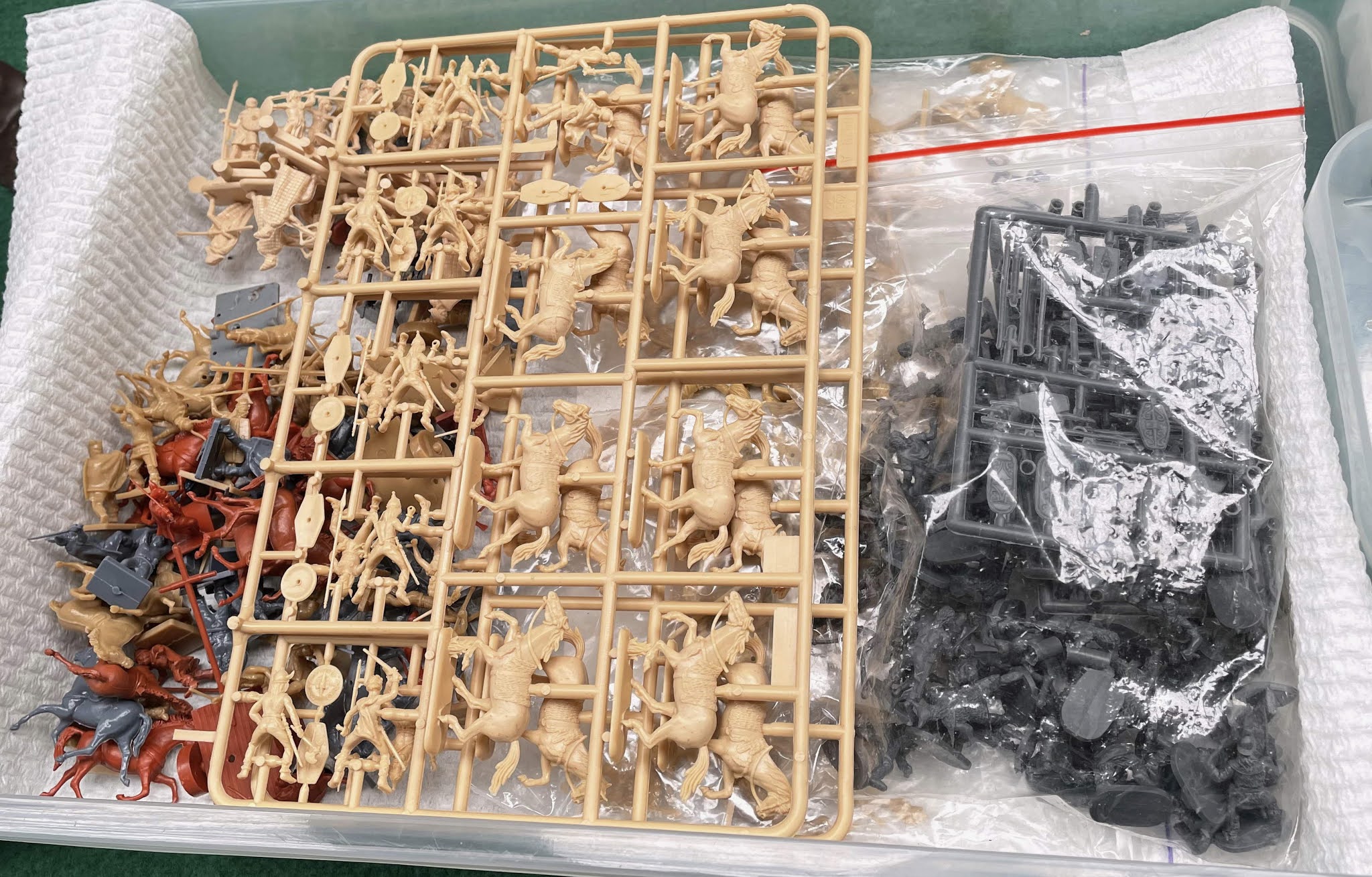
Gauls barely out of the box!

Having read it and been enthused and stimulated by the content I am now keen as mustard to have a go at playing/simulating a battle or three! I plan to bring ancient games into my schedule in 2023, with the 2080th anniversary of the beginning of Caesar’s Gallic campaign, beginning with Bibracte (around June, if possible). I have a reasonable number of Romans painted, but no Gauls/Celts/Britons (or Germans). Perhaps I’ll be able to have some ready a bit sooner; such is the excited state that this book has left me in.

Rating

References

Sabin, P (2013) Lost Battles Reconstructing the Great Clashes of the Ancient World. First Published 2007. Bloomsbury Publishing, London. 298 pp.

Whatley, N (1964) On the Possibility of Reconstructing Marathon and Other Ancient Battles. The Journal of Hellenic Studies 84, 119-139.

Battle Reports Using Lost Battles

The links below are to reports of games using Lost Battles from three blogs.

Game reports on Here's no great matter

Aaron's video of Trebia

Game reports on Parade Ground 20 mm

Game reports on Ancient & Mediaeval Wargaming


Wednesday, June 16, 2021

Book review: The History of Toy Soldiers

My father would have loved this book. It’s full of the model soldiers from his childhood, but so much besides. Such is the extensive history provided by Toiati that Dad’s nostalgia would only have begun a few chapters into the book!

With his aptronymic name Toiati was destined to this. He has produced a sumptuous book that is like an encyclopaedia of toy/model soldiers and their manufacturers down the ages. His descriptions and explanations are written with the knowledge of a master of the subject, but one who has an absolute passion for it.

This ‘encyclopaedia’ is arranged in historical and thematic chapters. The journey begins with four chapters about the history and development of figures from the earliest known toy/model soldiers to the birth of what he calls the ‘modern’ toy soldier—a chapter with plenty of photographs of lovely flats. The remaining 12 chapters are thematic around styles and materials of production, uses or both.

Some of the lovely flats featured in chapter 4
 
Model soldiers in action. This photo of some of Ian (Stryker)'s beautifully painted Hinton Hunt figures is from the only chapter about wargaming.

Toiati is not a wargamer. He has an understanding and even some appreciation of wargaming, but the book is about model soldiers as individual representations or used in their tens or dozens as playthings. There is but one chapter about wargaming*. I would have liked to have seen more photos of figures in ‘action’, hundreds and thousands of model soldiers used to represent history in dioramas or wargames and fewer presentation or cabinet-type photos; but that is the bias of the wargamer^. This is Toiati's book, not mine!

*Reminds me a bit of when Battle Magazine was absorbed into Military Modelling and content of the former was relegated to a few pages, amongst pages and pages of absolutely beautifully painted display figures.

^Mind you, a functional approach to toy/model soldiers was ‘drilled’ into me at a young age. We all played with Dad’s Britains figures, which received quite a bashing in the process, chiefly because he considered that toy soldiers were to be played with, not left in a display cabinet. In his later years he did have a few, selected purchases in such a cabinet, but, of course, we had the less-expensive, wargame figures for ‘active duty’. 

A two-page spread of some of the paper figures featured. I have some like these in an old scrapbook.

While not a toy soldier aficionado nor collector, there is still plenty in the book for the likes of me. There is the nostalgia associated with photographs and descriptions of flats, paper figures, elastolin figures, ‘classic’ wargaming figures and plastic figures. Added to this is the pure joy of seeing so many lovely pictures of beautiful figures, from makers around the world, some battered ‘veterans’ and others with a pristine paint-job. Many of the photos are from the author's collection, some from other collectors and quite a number simply taken from various internet sites (all sources are noted).

Some battered Britains, reminiscent of the look of Dad's old Romans after he and then we three offspring had played with them. (The ones photographed here are a little older though circa 1910).

Britains souvenir figures. The Henry VIII was amongst those that my Dad had.

Airfix French cuirassiers in one of the early boxes; part of the personal nostalgia for me.

A childhood favourite; mine were the Timpo version (currently stored in my wargames room).

Toiati states that he chose to limit his research up to around the year 2000 as his focus is on “…figures already part of history. Today’s figures will have to wait for their turn to be included.” His cut-off is a little earlier than this though as, of the more wargame-related figures, there is a description of Hinton Hunt, Les Higgins, Hinchliffe, Minifigs, Scruby (and so forth), amongst the metal figures, but none of Foundry, Élite, Essex, Front Rank, Dixon, Peter Pig, Warrior, Old Glory or any of the plethora of post-60s–70s manufacturers. In plastic we have Airfix, Matchbox, Atlantic and Esci/Italeri, but no Hat, Strelets, Zvezda and so on.

Nevertheless with its 621 pages packed with beautifully reproduced colour photographs and Toiati’s descriptive text full of interesting details and anecdotes, it’s a book that will naturally appeal to the collector of toy soldiers but also anyone who has had the pleasure of using and enjoying them as children or in adulthood.

Rating


Reference

Toiati, L (2019) The History of Toy Soldiers. Pen & Sword Military, Barnsley, South Yorkshire, England. 621 pp.

Monday, April 5, 2021

Verdun 105 (5): Book Review "Verdun 1916 The deadliest battle of the First World War"

On reading the first page of this book I was struck with two aspects. Buckingham commences with a wonderfully vivid and descriptive word-picture of the town of Verdun and surrounding geography. This immediately demonstrates the high-degree of readability of the book, thanks to Buckingham's excellent prose, and also the details of the content, so helpful to understanding the battle and providing useful information for wargaming-related activities.

The remainder of the first chapter is a pocket history of Verdun from settlement in 450 BC to the end of the Franco-Prussian war, including developments of the fortifications and the first two significant sieges of 1792 and 1871. The chapter concludes with a brief history of the Franco-Prussian War, setting up a changed France at the end of the 19th century.

The second chapter picks up from end of Franco-Prussian war and how it influenced French military thinking. Initially in construction of a new defensive line, including the camp rétranche de Verdun, at huge expense; up to 60–78 million francs once it had been updated several times in response to changing military technology. He describes how the French were at the forefront of military technology in terms of machine gun, field artillery and aircraft (although not so in heavy artilllery), but were stuck in a former age (revolutionary zeal and Napoleonic glory mixed with post 1829 ‘tradition’) when it came to uniforms (les pantalons garances) and particularly philosophy. His telling of the ‘battle’ over military philosophy and the victory of exponents of the attaque à outrance (including one General Joffre, appointed in July 1911 as chief of staff of the army making him head of the army in peace and supreme commander in time of war) is astounding in hindsight, but also given developments in other nations. Buckingham concludes, in a salutary note “…an operational philosophy tailored to solve the problems of 1870… attaque à outrance and Plan XVII were set to provide an equally updated method of feeding manpower into the maw” (p. 53).

Chapter three: It is war! From the declarations of war to the mobilisation and initial attacks of French troops. I'd not read nor heard perviously the amazing statistic of how hugely successful French mobilisation was in 1914 with only 1.5% (or about 1 600) failing to report (as opposed to the expected 13%). Buckingham praises Joffre’s organisation for this, but I suspect that the bravado of the populace in supporting the war in August 1914 was also a contributing factor. Initial diversionary attacks by the French into Alsace-Lorraine and Ardennes met with some success, but were soon blunted. We learn of the first of the French general’s to suffer from Joffre’s limoges (his tendency to sack generals who were unsuccessful and transfer to Limoges so as to not have disgruntled generals in Paris). The statistics of the first weeks' fighting for the French; 260 000 casualties, 75 000 dead, 27 000 killed on 22 August. The dead included 4 778 officer (1/10th of the army’s officer corps). This was not, however, really related to attaque à outrance or gaudy uniforms as German casualties were similar. Rather it was due to the killing power of rapid firing artillery, rifles and machine guns and the power of defence over attack. In leading us to Verdun, Buckingham describes the bombardment and capture of Fort Manonviller in some detail, the incorrect conclusion of the French that it was destroyed by artillery, when in fact blown up after capture to prevent use by French—was an important lead in to Verdun (an important note that I had also read in "Verdun 1916: renaissance of the fortress"). Having until  now focussed chiefly from French perspective, Buckingham now switches to introduce German plans for war.

He describes the Schlieffen Plan and its implementation by von Moltke and how it contradicted French expectations, thinking and planning. The logistics of the planned movements are astounding, but, of course, it did not quite go according to plan and was adjusted due to needs in the east and revisions of von Moltke. He briefly covers the Battle of The Marne, race to the sea and establishment of the lines of the western front, pointing out that Germans held the most advantageous geography, leading to wasteful French and British attacks in 1915. The exception to this was the Verdun salient. Buckingham goes back to describing its formation along with the Saint-Mihiel salient. The chapter ends with the German destruction of two of the three railways feeding Verdun, leaving a “30-mile long narrow gauge military railway and parallel road running south-west to Bar-le-Duc as its line of communications. This rather tenuous link was to become more vital than its builders could ever have imagined” (p. 80).

In chapter 4 he describes events leading to the Battle of Verdun. Changes at German HQ after the failure of Schlieffen plan, defensive strategy in the west by Falkenhayn to allow attacks in the east. The fruitless French and British attacks in 1915 in attempts to wrest the high ground. This demonstrated clearly the power of the defence and that, while they would not lose war, Germany could not win by defense alone. So we have the development of Falkenhayn’s plans for attack in the west. The choices of Verdun or Belfort. Settling on Verdun. Buckingham describes the planning and logistics of the operation in great detail which, thanks to his fine prose, makes for easy, interesting and impactful reading.

From chapter 5 on Buckingham describes the battle in detail, comencing with the initial Geramn attack of 21–28 February 1916. As with Kaufmann and Kaufmann in "Verdun 1916: renaissance of the fortress", Buckingham provides an overview of the entire front, but he focusses more on the actions of smaller formations with more detail of sections of the battle. This includes units involved down to regiments, battalions and sometimes companies. This is complimentary and helps with the building picture of the battle that I am getting. His details of the unit numbers of men and locations are particularly useful to understanding events but also in planning any sort of re-fight (once again this compliments Kaufmann and Kaufmann which provided insights into the more detached outlook of the C-in-C (wargamer) for whom the lowest level of formation of note is the division).

Above and below, two of the double-pages of plates showing contemporary and modern images of the battlefield.

Buckingham continues this approach over the remaining five chapters, combining a strategic and tactical overview, with detailed descriptions and plenty of eyewitness accounts/recollections. These cover events of 6 March–29 May, the escalation of the attack to include the west bank (chapter 6); 29 April–1 June, attacks on both banks (chapter 7),; 1 June–8 June the German capture of Fort Vaux (chapter 8);  8 June–12 July final German attacks (chapter 9). The book's final chapter describes from the effective end of German offensive operations, the recapture of Fort’s Douaumont and Vaux in October-November 1916 through to the final recapture, in October 1918, of all territory lost in those ‘five days in February’. Along the way Buckingham tells us of the fate of the generals of both sides post-Verdun; the transfer to lesser fronts and eventual fading into obscurity of Falkenhayn, von Knobelsdorf and Joffre, the eventual reconciliation and interment in Les Invalides of Nivelle and Magnin (despite their leading part in the disastrous Battle of Aisne and mutiny of the Chemin des Dames in May-June 1917) and the sad tale of Pétain’s ‘transformation’ from hero and saviour of '16–'18 to villain and scapegoat of '40–'45. He concludes by telling us of the post-war clean-up (or covering) of the battlefield, establishment of memorials, shrines and visitor’s centres and dedication of Verdun as the World Capital of Peace, Freedom and Human Rights by the United Nations.

The anecdotes/recollections and detail in the chapters provides numerous interesting, moving and/or amazing pieces of information for the reader. A few examples will serve to illustrate this point

This from Feldwebel Karl Garner Infanterie  Regiment 243 on 4th March:

All I have told you, dear mother, is false. We have been badly informed by our officers. We are just maintaining our position on the ground we have won after fearful losses and we must give up hope of taking Verdun. The war will continue for an indefinite period, and in the end there will be neither victors nor vanquished (p. 158).

For the bombardment of Fort Vaux, the Germans gathered 2 200 guns, but
…their performance had been severely downgraded by this point because the gun barrels were approaching the limit of their useful life, having had more shells put through them than the manufacturers envisaged (p. 191).

Despite this,
…the intensity of the German preparatory bombardment did much of the assault troop’s work for them. The 28e Régiment d’Infanterie’s 3e Bataillon manning the Ravin de Bazil sector of the front line was virtually wiped out in the course of the night for example, and the unrelenting shelling reduced the 1er Bataillon to just eight men when it attempted to counter-attack the position from the support trench line (p. 192).
The description of the German attack and eventual capture of Fort Vaux in June is particularly engrossing, awe-inspiring. The combat above the fort and in the tunnels was described in some detail by Kaufmann and Kaufmann, but Buckingham dedicates an entire chapter to it and so tells the tale of this horrible and heroic fight in more detail, with numerous quotes. The word-picture is astounding. Men inside the fort, resisting desperately against attackers also in the fort’s interior, others outside and on top, desperately trying to break-through, while repulsing French counter-attacks. The deliberate calling down of ‘friendly fire’ upon the fort so as to try to dislodge or at least to disrupt the attacker s without. Then, the eventual surrender of the beaten but unbroken, wretched and parched survivors of the garrison who were well treated by their captors, despite the latter having suffered some 2 742 casualties in seven days of desperate fighting to wrest the fort from its 300-odd strong garrison (support from Fort Souville and under-manned relief attempts).
 
A final example on the state of the battlefield not long after the capture of Ft Vaux:
… the physical state of the battlefield, which constant shelling had ploughed into a cratered, milky brown desert bereft of foliage or shade. Water was therefore a key requirement but had to be brought forward by hand with the limitations and risk that entailed; only twenty-eight of ninety-five water bearers from the Bayerische Leib Regiment despatched to Fleury during the night of 23/24 June got through, for example (p. 227).

One of the maps in appendix 1, this showing the front lines before the initial German offensive and the firing lines of the German batteries.

Book includes two appendices. The first contains six maps showing the Verdun front, city of Verdun, initial German offensive with locations of gun batteries and firing lines, supply lines of Verdun, area of the initial German attack indicating the front line on each day, and both the east and west banks with German lines in March. All of these maps are clear and sufficiently detailed, but, amazingly, only the map of Verdun has a scale! The second appendix is a listing of the approximate strengths of different levels of formation in each army, from section/platoon to division. 

Each chapter has a large number of notes on the text. These relate chiefly to the sources used which, in Buckingham’s case, are mainly secondary sources. They are well-respected histories all, but nevertheless indicate that he has not returned to archival or other primary sources himself. 

I began by praising Buckingham’s prose. The book is a most readable account. Unfortunately though, some repetition occurs around the middle of the book. I am not sure whether this is proof-reading fatigue, poor editing or related to the deadline of having it published in the centenary year, but it is both annoying and disappointing. For example, on page 174 we read that “… Nivelle and Magnin started as they intended to go on”, only to be told on page 175 that “Nivelle and Magnin had begun as they intended to continue…”. Then, on page 180, regarding the General Magnin's planning of the (failed) French attack to retake Fort Douaumont in May, we learn that Magnin was “…less than impressed when the fort’s [Fort Moulainville] commander, Capitaine Léon Harispe, respectfully pointed out that the 370 mm howitzers were likely to prove inadequate as Moulainville had withstood two weeks of regular bombardment by more powerful German 420 mm pieces without suffering significant damage. Magnin was reportedly less than impressed with the news.” There are a few other examples in the chapter, though mainly words repeated in a sentence so not as bad, and I did not detect such poor proof-reading in any of the other chapters.

Overall, this is a fine book about ‘the infamous western front battle’ (to cite the promo. on the back cover) and one which provides the reader with copious detail and richness in a most readable account. On opening the book I was surprised to see that the chapters began back in ancient times, but it became clearly evident why Buckingham had provided this level of background and it is in fact critical to the reader’s understanding of the epic struggle of 1915.

I borrowed this book courtesy of the State Library service through our ever-helpful local library. I would not have been disappointed in the least had I purchased a copy.

Rating


Reference

Buckingham, WF (2018) Verdun 1916 : the deadliest battle of the First World War. First Published 2016. Amberley Publishing, Merrywalks, Stroud, England. 320 pp.


Saturday, March 13, 2021

Verdun 105 (3): Book Review: Verdun 1916 The of Renaissance of the Fortress

Just like the participants of the real thing, particularly those forming grand strategy, I am learning as I go along. The serendipity of having it to hand meant that the Kaufmanns' book has marked the beginning of my detailed reading about Verdun. It was a great place to start.

This dense book is one that you would swear is greater than its 248 pages (plus index). It is a detailed description and analysis of the ten-month Battle of Verdun and the role of the fortress and fortifications in that terrible campaign—plus far more.

The book’s headline title is ‘Verdun 1916’, yet we do not get to the first day of Verdun until page 140. This is not a negative, but a most positive aspect of the book since the first 139 pages are devoted to detailed and essential background, description and analysis of events leading up to 21st February 1916; and plenty about the forts and fortifications.

The first chapter is a summary and overview of final road to war and movements on all fronts from July 1914 to the end of 1915. It provides insights into the strategic situation that lead to Verdun but is also one of the clearest and lucid descriptions of the course to and of the war that I have read (heard or watched).

Each chapter contains sidebars with details of a specific aspect that is relevant to the chapter’s topic. In chapter one these sidebars are casualties during the first fifteen months of the war compared to later (particularly for the French), the challenges to providing the resources for the war matériel and a brief biography of General Petain.

The second chapter on fortresses and fortifications begins with an inventory (location and state) of the fortresses of each European power at the outset of the war in relation to their plans. This is a key chapter of the book, hence it’s 47 pages. The chapter’s sidebars are about artillery and turrets, siege artillery, balloons and modern trench warfare (prior to the First World War). Details about fortifications, designs, dimensions, thickness. design of armour, armament and placement in this chapter are fascinating and edifying but will be super-useful in trying to model such things for the wargame table.

An example of some of the numerous photographs in the book, this a double-page spread showing the turrets of several of the forts around Verdun.

In the third chapter we move to the campaign leading to the attack on Verdun in early 1916. The Kaufmanns describe the creation of the Verdun salient, the St Mihiel salient, the French small attacks orchestrated by Joffre in 1915 in the Argonne/St Mihiel salient. The failure of what had gone before meant a new approach (even though, to our modern eyes and to the men of the time, it did not seem much changed). The options for both sides are discussed and how they came to both plan offensive measures for 1916. Sidebars describe the dismissal of General Sarrail as Joffre’s scapegoat(?)—a bit of a ‘habit’ of his—and the development of air power that would lead to the use of aircraft of various sorts in the Verdun campaign.

Chapter four begins with the planning of the battle, brief biographies of the main generals involved and then describes in detail the “five days in February’’. In the book’s introduction the Kaufmanns state that there is uncertainty as to what Falkenhayn’s objectives were. Several times in this chapter they mention that Falkenhayn is not recorded as having stating his objective to ‘bleed the French white’ until his memoirs years later. The authors seem to suggest that the objective was to bring the French to a battle, engaging men and matériel so as to weaken other sectors of the front. Perhaps, if the Somme offensive had not been initiated by the allies, the Germans would have attacked elsewhere? Falkenhayn realised that, in a long war of attrition, the Germans would come off second best, so he wanted to take the initiative, hence launching the attack in February, on a narrow front and against a position that the French held dear. The summary of the first five days and what could have been demonstrate how it was part of the evolving of warfare in that most terrible conflict. One can almost see it as a ‘training ground’ for the far more successful, targeted and aggressive operation Michael (the Kaiserschlacht) in the autumn of 1918 (though that too ran out of ‘puff’). I wonder how different that might have been had the flower of Germany’s army not been squandered at Verdun? Sidebars discuss evidence regarding Falkenhayn’s aims, the timeline of the five days in February (known and unknown), impressions of the results of the first five days from the generals of both sides and Falkenhayn’s strategy for the initial attack.

The fifth chapter covers the battle from March to December. There is a detailed description of the German attacks of early March and French counter-attacks of early April. The development of each side’s system of rotating divisions (more frequently by the French), defence in depth, machinations and tensions of high command, political influence of President Pointcaire in the need to hold Verdun (to maintain his government) and the determination of the Poilus to defend their motherland all come into play. This chapter focusses on the battles for the forts. In the course of the narrative the Kaufmann’s describe Forts Douaumont, Vaux, Moulainville and Ouvrage Thiaumont, Laufée, Froideterre assisted by diagrams, plans and photographs. The approaches of the two sides to relieving the front-line troops are illustrated by examples of the movements of divisions to different sectors and between Verdun and the Somme. Most of the narrative is at the senior command level, so we read of the movements of divisions and corps, in and out of the front line. This shows the scale of the operation and that the minimum, relevant ‘manoeuvre element’ was the division, adding to the distance of senior command from the frontline. An exception to this is a detailed description of the German capture of Fort Vaux in late May. Firstly outside and then within the confines and corridors of the fort. It is harrowing stuff. Sidebars cover the Somme and the logistics of supply for the French, repairs to road and rail to form la Voie Sacré

The conclusion looks at the battle’s effects on the war and the careers of main generals involved. There are some long quotes from Hindenburg’s reflections on the battle and its lessons. These make for particularly interesting reading, being from a German general who had his forces in the east decreased in order to allow the attack to occur, but who seems to have been supportive of the campaign*. They add further credence to the implied conclusion of the authors that Falkenhayn’s aim to ‘bleed the French army white’ was a later interpretation while to remove the Verdun salient, create a weak-point from which to defeat the entente forces or even to draw in further troops so as to provide opportunities for a strong attack seem to be the more likely aims at the outset.

The book contains many tables, maps, illustrations and photographs. These add detail and understanding for the reader, but, more importantly for me, will help greatly in recreating the battle. The table listing the units of German assault formations and target French formations and units in the initial attacks is but one example.

One of several tables; this provides an order of battle for the first five days.

Maps, in copious quantity are to be found in the pages of the book. These range from the entire western and eastern front to specific areas of Verdun and fortresses. They are excellent to follow locations and details in the text. Several of them are quite small and many are missing a scale, but, as with the book as a whole, they build in information and detail along in line the text making it easier to get an understanding of events over such a large area. These too will be invaluable to me for any wargaming of the battle.
Plenty of maps, which is always great! Some strategic (above) and others relating to Verdun overall (below) or specific parts of the 'battlefield'.

An appendix, providing an overview of weapons of trench warfare (German, French and British) and developments during the war up to and after Verdun, glossary of terms, especially those relating to forts and fortifications, detailed notes on each chapter and a bibliography of chiefly secondary but also some primary (memoir) sources round out the book.

There is much repetition in the text. While you say to yourself that ‘I have read this before’ it is not straight repetition and is part of the way that the authors build the story, so in each case it is more a reference back to a previous point now made in a broader or more specific context or with the addition of more detail or nuance. Therefore, overall, I found this a bonus, rather than a detraction.

Occasional typos (chiefly duplicated or missing words) and grammatical mistakes do detract a little, but these are few in number and, let’s face it, as someone who has written reports, papers (and blog posts) I know that even with the best of intentions, duplicate proof-reading and editing such things slip through.

This is a fine book and, as I mentioned at the outset, I am pleased that it was the one that launched me into learning more about Verdun. I will be referring back to it time and again, especially in the coming weeks and months.

* I have fairly loosely and interchangeably referred to battle and campaign. While the largely stationary actions of the First World War are commonly referred to as battles, I find it more useful (for me) to consider them as campaigns with the sections and phases as battles.

Rating

Reference

Kaufmann, JE and Kaufmann, HW (2016) Verdun 1916 The Renaissance of the Fortress. Pen & Sword Military (an imprint of Pen & Sword Books Ltd), Barnsley, South Yorkshire, UK. 255 pp.

Thursday, October 29, 2020

Book and Troop Review: Les Fantassins de la Grande Guerre and First World War German Infantry

I was looking for a single volume that would cover the uniforms of the First World War, following my decision to have a go at wargaming the period. Unlike my beloved Napoleonic period, I did not feel the need nor desire to purchase several books on the topic. Nevertheless, I wanted more than one can get from internet sources. I looked at some of the books readily available in English, but could not find anything beyond those from Osprey. I have never been particularly enamoured with Osprey’s offerings and did not want to purchase three or four books and then only have information about the Germans and French, so I looked further.

Along came Éditions Heimdal to the rescue. I found Guillemet’s book on their website in March and it looked to be exactly what I was after, so I ordered it immediately. I was not disappointed in the least.

Published in 2018, its 256, A4 pages are packed with full colour photographs of uniforms, uniform items, equipment and weapons. These are enhanced by contemporary photographs of troops in the field and the studio. Together they provide a photographic description of the uniforms from 1914–1918, presenting all of the items that I could want and highlighting changes over the course of those four tumultuous years of war. The text and captions, describe details of what is shown in the photographs.

The items presented in the book come principally from the Musée royal de l’armée et de l’histoire militaire de Bruxelles. They have been photographed with excellent lighting and compositions so that details, colours and event texture can be clearly discerned.

Example of pages featuring items of equipment and a contemporary photograph (studio in this case).

Example of a double-page spread showing a mannequin in uniform and different styles of greatcoat.

Table of contents: all nations are included.

In line with my desire, infantry uniforms for all of the belligerents are presented; France, Germany, Serbia, Russia, Belgium, Britain (and Dominion), Austria-Hungary, Japan, Italy, Portugal, Bulgaria, Rumania, Czechoslovakia, Poland, United States and Turkey. More pages are devoted to the key, European powers than to the ‘lesser’ ones. However, there is great efficiency in the images and text so that the main details and changes in uniform of troops of a nation like Portugal are covered adequately (for me) in two pages. The colonial forces of the main powers are also included.

A nation like Portugal is covered in sufficient detail
in just two pages

As you will have gathered from the title, the text is in French. It is clear and straightforward enough that I am able to comprehend it easily with my intermediate knowledge of the language. However, if you do not read French, the images are sufficiently self-explanatory, and numerous, as to be comprehensible in their own right.

This is a fabulous book for anyone interested in uniforms and equipment of the First World War. If, like me, you are looking for the one book, this is it.

Ten Napoleons

Troops: First World War German infantry

German Army basically ready to go

My approach of having large numbers of figures, across a few periods, on the go at once means that I may swap and change what I am painting on any one night. It also means that my focus is quite, ‘fluid’. The past couple of weeks have been a case in point. I had intended to focus principally on the first couple of units for my 17th–19th century Ottomans but, while I have made some progress with them, I have ended up making most progress with First World War Germans!

The Deli cavalry, showing brown applied which lead to a painting First World War infantry!

I began painting the Deli cavalry for the Ottoman army, as planned, starting with browns for the animal skins that they wore. Then, since I was painting brown, I looked for other troops to use up the paint that I had ‘decanted’. First World War Germans with all that brown kit were an obvious choice!

The Germans I am painting are aimed for mid-late war and are a mix of Caesar WWI German Army, Emhar German WWI Infantry with Tank Crew and German WWI Artillery and Strelets German Stormtroops and German Infantry in Gasmasks. The Caesar and Emhar figures are sculpted somewhat ‘finer’ than the Strelets. I’m happy with all of these figures, but particularly like the ‘chunky’ style of these earlier Strelets’ offerings.

From left: Strelets, Emhar, Caesar and Strelets figures. These mix well, I reckon.
A Strelets flame thrower between two Emhar figures.

Strelets produced British, French, Russian, Austro-Hungarian and German Infantry in gas masks as part of their range of figures for the First World War. The Germans are now out of production, so I did not think that I’d be able to get any. Fortunately, a tip on the Strelets forum lead me to Fausto Mancin at the Lucky Toy Soldier and I was able to obtain a set from him. I like them so much that I may even get another box.

Strelets German Infantry in gas masks, almost completed,
Hart wie Kruppstahl
 
The Emhar WWI German Artillery includes two 77 mm Krupps field guns and four MG 08 machine guns. Interestingly, there is a surviving Krupps field gun beside the cenotaph in town that was captured near Villers-Bretonneaux in August 1918. It's nice to be able to compare the model with the real thing. The machine guns in the kit come with only a single crew man, so I did some simple conversion work with some of the artillery loaders to turn them to feeding machine gun ammunition.

77 mm Krupps field gun beside cenotaph in York, WA


The adjacent cenotaph and detail (below).

Second model 77 mm Krupp field gun, staff and one of the MG 08 machine guns with added crew. The kneeling officer in the machine gun crew is a conversion with legs remove and replaced with those from a kneeling Airfix French cuirassier.


With these Germans nearly completed, and just a few more French that I want to also finish off, I am now really close to having a go at a first game of World War I wargaming. I may get to start this weekend and/or week nights next week.


References and links

Guillemet, C (2018) Les Fantassins de la Grande Guerre. Éditions Heimdal, St Martin-des-Entrées, Bayeux, France. 256 pp.

Caesar Miniatures website

Emhar range on Plastic Soldier Review

Strelets’ World War I sets