Wednesday, April 20, 2022

Joy of 2 for World War Two

After our back to the future playtest of the Wargames Research Group 1925–1950 rules, Julian came to the conclusion that he was happy with the rules, but not the scale. While I might be prepared to 'suspend disbelief' regarding the depth a vehicle occupies, he could not have a great big 1/72 Tiger (for example) and assume that it only occupied a smidgen of it's size. The answer, he thought; 2 mm.

Using the natural scale of the figures (1:1 000, rounding up) means that the ground scale becomes 1 mm = 1 m, what you see is what you get and large games can be staged over a reasonable area.

He proceeded to purchase some 2 mm figures for the Second World War from Irregular Miniatures (already knowing the scale since he has plenty of 2 mm forces for other periods), applied paint, made some buildings and then, on Sunday just gone, staged a second playtest. Stephen came up from Perth to join Julian and me for the game.

Julian designed a fictitious scenario a few days after D-Day, on a roughly 1 m x 2 m table with some really good looking bocage (using strips of kitchen scourers) and some buildings that he has scratch-built from milliput. I took the defending Germans, Stephen the attacking Americans.

View along the table from the American end. Green strips are bocage, large hill at the German end of the table, village behind.

View from the German end. Troops laid out but not deployed. Julian's excellent buildings in the foreground. He has applied his master building for 1/72 to 2mm.

Americans advancing down the road and across country. My plan, if I had any, was to conduct a 'rolling defense', with each line of hidden vehicles/troops retiring to the one behind (or further). I 'unveiled' the first line of a Jagdpanzer (right foreground) and Panzer IV (left foreground), each supported by an infantry.

German tanks open up on the lead Sherman, knocking it out! We played all of the American tanks as Shermans (which these lead ones here are).

The Americans had laid down a smoke screen/barrage, which fortuitously, for me, over-shot the first line of German defenders. This did not last long as their tanks fired on the now visible Jagdpanzer and Panzer IV, taking out the former, but missing the latter.

Scratch one Jagdpanzer.

According to plan, the Panzer IV and infantry that had accompanied the Jagdpanzer now retired towards the next line: A Tiger. The other infantry remaining in place for now as observers. The Tiger opened up on the lead tank, but missed.

Not so the German artillery which had been called in to fire a little in advance of the initial American position and successfully destroyed another Sherman, second last in the column.

The lead Sherman diverted from the road to attack the retreating panzer grenadiers, but good fortune continued to be with the Germans and they escaped unharmed.

To add insult to (non) injury, the infantry fired their panzerfaust, and hit and knocked out their assailant!

Surviving the American retaliatory fire, the Tiger opened up again...

Sherman no. four of six knocked out.


At this point, Julian remembered that we'd forgotten morale tests. The result for the American company of Shermans meant a retirement to cover away from the enemy. The German infantry that had been fired on by the tank but survived did a similar thing.

We had to end it there. Originally when we'd planned the game we expected to go into the evening, but I found out later that I was working on Monday with an early start, so we were limited to the few hours. Nevertheless, it was a wonderful time with marvellous hospitality from Julian and family, an enjoyable first outing with his twos and plenty of banter and general chatting/catching up. A huge thank you to our wonderful hosts!

Julian is now 'full steam ahead' to paint more vehicles and figures and to build more of his marvellous buildings and other terrain pieces.

Sunday, January 30, 2022

The active queue

I did a tally. Currently I have 2 072 in my queue of figures to which to add the 'finishing touches'. This comprises figures that are <50% to 95% completed; although more of them are at the upper of that range.

No wonder I only seem to progress them a little with each painting session.

Nevertheless, progress is being made (and enjoyment being had). We’ll see how long it takes me to get them all out the other side!

Queue from the western end. Discernible in the foreground are Saxons and Poles from the recent game of Klissow—plus a few more added in—along with Polish-Italian legion uhlans and some Grenz hussars.

Queue from the eastern end. In the foreground are those 1796 French (still waiting for some white!) along with some early French in greatcoats and Oudionot 'grenadiers', also seeking uniform items deviendront blancs.

White has to wait a bit longer though, as red is the colour of the moment. Saxons (at left) and Prussians (right) of the Great Northern War. The latter were my most recent (and last) addition to the current queue.


Saturday, December 18, 2021

Oldie but a goodie

A fabulous afternoon/evening yesterday at Julian's combining plenty of discussion and chatter about a range of topics, a delicious meal and a playtest game using the Wargames Research Group 1925–1950 rules.

Germany late '44-early '45: a Russian advance in force.

Julian had wanted to do a test-game using the rules; a set that he had used in his teens and early 20s and suspected would be a 'viable' set for the sort of level of Second World War games that he'd like to do. Back in August, we had a go using Blitzkrieg Commander, but soon decided that they were not for us. For me the main negatives were biggies: the way the rules handle command and control with command rolls and completely random blunders as well as the combat system of hits and saves. Julian was not enamoured by these mechanics either, but the key blocker for him was the scale/organisation of the game into 'units'. He wants a tank to be a tank, with different effects if fired on from front, side or rear. He previously had this using the Wargames Research Group 1925–1950 rules. These had 'failed' previously due to the inability to replicate attacks by less-good armour against superior types—more on this later.

The Wargames Research Group 1925–1950 rules; an oldie, fondly remembered by Julian, never played by myself—would they still be 'in play' after this game?

Julian's scenario of the game was the same as we had used for the game using Blitzkrieg Commander, a fictitious encounter set in late '44-early '45. A large, advancing Soviet force of infantry and several T-34 85s against (basically unlimited numbers of each, but coming on a few at a time) against a smaller, but reasonably well-equipped German defensive force of a Panther, a Panzer IV, a 28 mm sPzB 41, a panzerfaust & crew and around a half-company of infantry. I had a vivid image of the scenario as it was reminiscent to me of the wonderful series of games played recently by Jon on his Grymauch's Solo Wargaming Blog (final part here, work backwards to see the others). Interestingly, Jon had used Blitzkrieg Commander.

The Russians advanced, initially down the road, then diverting two tanks to their left.

Seeing that enticing bit of side armour, I 'unveiled' my ace, the Panther, hull down in the wooded area (as well as some of the accompanying panzergrenadiers. Unfortunately it failed to hit.

More Russians enter the battle area, as the former lead tanks head around the buildings...

... straight into the spider's web!

Scratch one T-34. In my excitement at this single 'victory', I made my first and biggest mistake, but more on that later.

More good news, if you are the German defenders, as the new lead T-34, no. 47 as it happens, is knocked out by the Panther.

"But still, they come" (apologies to Jeff Wayne).

'Sneaking' around the hill, a shot at the Pz.Kpfw IV fails to strike home.

Despite numerous targets and selecting those that were stationary, the Panther could not repeat the dose. Mind you, the Russians too missed several times—we were both rolling 1s and 2s, using the same die and were beginning to think that it was 'broken'!

Time to bring some of the infantry into action. They missed and were knocked out by the right-most T-34.

As was the Pz.Kpfw IV! The crew paid dearly for my mistake. I should have retired/retreated after the initial success, rather than getting excited about taking out more of the Russian armour.

Not gonna make the same mistake twice though. 'Saddle up!'. Time to move to another position while we could.

End of the game. A Soviet strategic victory, clearing the defenders with losses near even: two T-34s against a Pz.Kpfw IV and some infantry. I think we all know which side could handle even that kind of trade-off for longer!

A really enjoyable game. Enough interest and challenge for both players and a plausible result. We could have rolled on to another table (as Jon did over ten tables in his excellent series), but it was enough for us to be content with the rules in playability and realism.

The added detail of individual tanks, specific classes for armament, two levels of armour and small groups of infantry had not added a great deal of complexity, but had boosted enjoyment and scale of approximation. We used the nominal, base scale of 1:1000 (1 mm representing 1 m), so there was a large degree of 'suspension of disbelief' regarding the size, especially the depth of the vehicles. This did not cause any problems at all. Julian had the fine notion of considering the depth to represent an area which the target occupies in a particular 'bound', a concept that appealed to me. Adapting thinking from naval wargaming, now that I think of it.

What was different between this game and the experience in his late teens-20s?

We suspect it was 'youthful exuberance': a lack of historical perspective and excitement at building numerous of the 'sexy' German tanks and then having them all on the table. An attack by T-34s against equal numbers of well positioned and equipped Panthers, Tigers, King Tigers and Jagdpanthers didn't work. The latter simply stood back and cleaned up the T-34s. In our game I coulda destroyed four T-34s (shoulda, oughta according to me!) for the loss of the one Panzer IV. It was looking a bit concerning for the Russians at 2-0 and should have remained as such or better if I had got the Pz.Kpfw IV out of harm's way when I had the chance. Mind you, there was that hit on the Panther that failed to penetrate, but that is another story...!

Might-have-beens aside, it was success and an initial tick of approval for an oldie but a goodie!

Rules

Wargames Research Group 1925–1950, 1973 with amendments of a 2nd Edition Prototype (1975).

Scales

Tanks and vehicles 1:1 (although the latter were a bit under-represented due to limited availability at this stage).

Infantry 'elements' of four figures (men) representing part of a section.

Figures

Russian

T-34s: Airfix ready-made HO-OO T-34 Tank
Infantry: Airfix Russian Infantry (1964)

German

Panther: Airfix 1/76 Panther kit
Panzer IV: Airfix 1/76 Panzer IV kit
Tractor: 1/72 Airfix kit
Half-track: Matchbox 1/76 PK-83 Sd.Kfz 251/1 Hanomag
Infantry: Airfix German Infantry (1961)

Sunday, November 28, 2021

An old metal puzzle

I am hoping to get some help with identifying some figures.

I have been enjoying myself over the weekend creating the last of the databases for my figures: of the few, remaining 15 mm figures that I have, all for the French and Indian War (I already have one for the 1/72 collection (main one) and smaller 1/32 and, recently done, 2 mm figures).

Creating this database has been/is great fun and really interesting as I had to work out what was what. Then, I found that I had kept the original orders and/or invoices for most of them (circa early 90s), which made the task much simpler. All, except for the few shown in the photos below.

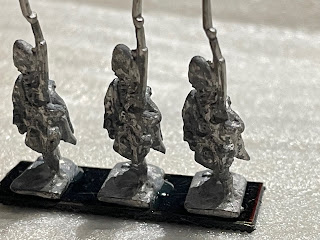
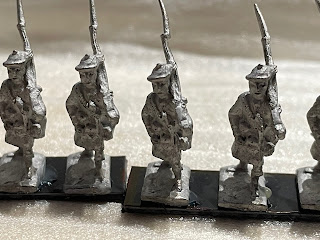
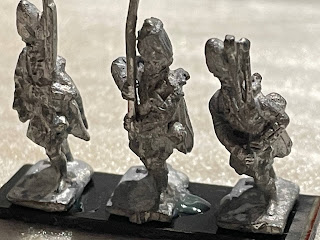
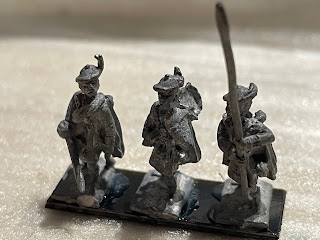
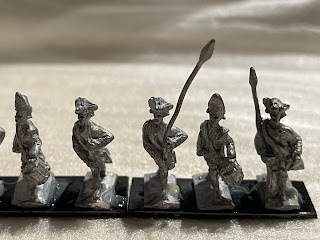
I think that they are Minifigs, but I cannot recall what they are or even where I got them from—really strange as the circumstances for the others came back as I thought about it and looked up the information that I had (then I got the exact details, which made it easier!). They are 'nominally' figures for the French and Indian War, but I cannot find a match amongst any of the current version of the Marlburian & Great Northern Wars, Jacobites 1688–1746, Seven Years War, Montcalm & Wolfe or American Revolution series.

Any suggestions welcome!


Above and below, Highland grenadier company.


Above and below, Highland centre company.

Above and below, Highland grenadier command (interestingly the standard bearer has the novel headress of the figures that follow these below).

Above and below, I am assuming a Highland grenadier company, but are they even Highlanders? Likely early 18th century and perhaps Jacobite?

Above and below, Highland centre company command

Above and below, British centre company command.

Just a few more entries and I'll have this, last of my databases completed. Unlike the others, this one will/should be a pure repository rather than an 'acitve file'!

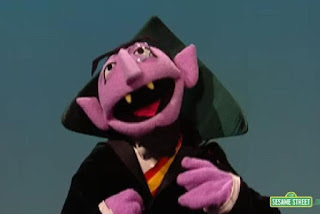
I like counting!!

A Sesame Street favourite; second only to Grover for me [Image: www.sesamestreet.org]

This skit from the wonderful 'Not the Nine O'Clock News' immediately came to mind.


Thursday, November 18, 2021

Further wonderful voyages of serendipitous discovery

The beauty of my painting approach, having lots on the go at once, is that I can switch from one subject to another and/or take advantage of figures that are 'nearly there'. So it was recently that, painting Polish-Italian legion uhlans for 1796-97 lead me to think that I should get on and finish some Polish Winged Hussars at the same time. These latter have been sitting, for several years, needing 'only' a black wash, highlights and varnishing to be completed. 

"Righto, in they go."

Husaria! Scene from the film "Pan Michael"

'Cept it ain't that straightforward.

I had borrowed the first volume of Norman Davies' History of Poland (reviewed on my Napoleonic blog), chiefly to get a bit more of an understanding of the Kościusko Uprising. It gave me far more besides. Reading this book, along with the fact that Julian and I had planned to catch up to do a game of something at my place, made me think,

"How about I use those nearly completed Great Northern War figures and we do that game of Klissow that I have been thinking about?"

Yeah, 'cause then I can use it as an impetus to get on and finish the Saxons (and perhaps the Swedes as well), either before or after the game.

Great.

Oh, I need more Poles. No worries, I had some prepared, some even undercoated, so just 'throw 'em in the mix'. 

So, the focus switched from completing a few figures to making figures that I had undercoated and others not yet started presentable enough on the table. I nearly got part of the way there.

'Fortunately' we did not complete the game and so decided to catch up for a second session. This meant that I was able to add more colour to the troops in the time between the two.

I am now back to step one, but with added figures for the Great Northern War to be completed along with my early French and Austrians for 1796–97. Just a lot more of them now. All good.

Saxon and Polish forces packed away after the recent game of Klissow and ready, along with additional troops, for some more painting.

More, predominantly Saxons.

Swedes and more Poles.

Polish cavalry and some of the early French 'Napoleonic' infantry behind (these are all part of this extended production line).

Along the way there was some wonderful, related but serendipitous discovery.

Painting tends to make me look at books videos and such related to the period (over and above looking for details of uniform and the like). Also vice versa; reading books inspires me to paint figures of a particular period. I don't think that I am alone in this.

I had saved a couple of extracts of a show in Polish "Ogniem i Mieczem" (With Fire and Sword) in my sub-folder called 'Polish Winged Hussars' within my Audio and Video collection. I went looking for more of it.

Serendipitous discovery 1: the entire file of "Ogniem i Mieczem" (With Fire and Sword).

Having watched that I became aware that it was part of a trilogy, based on some famous, fictional books of the same name.

Serendipitous discovery 2:  the films Potop (The Deluge) and Pan Michael (Colonel Michael).

This trilogy of films were produced by a famous Polish director named Jerzy Hoffman. They were produced and released in reverse chronological order, so Pan Michael, then Potop, then Ogniem i Mieczem.

They are magnificent films.

The versions that I found online are in Polish, without subtitles, so I do not understand a word (perhaps one or two words, but precious little). It does not matter at all. The filming is sumptuous and powerful. There are magnificent scenes of the Ukrainian and Polish steppes, wetlands, large areas of ripe crops in summer, deep snow in winter. Rain, mud and marshes. The divide between peasant and noble is captured brilliantly. The in-fighting amongst the nobles, joining together when threatened. The tragedy and loss of it all. The battle scenes are magnificent (even if all the cavalry, including the Winged Hussars charge in really loose formation). Furthermore, the films are a great source of ideas of colours for troops that had non-uniform dress. Oh yeah, there are some lovely female leads too!

Winged Hussars attack a line of Cossack infantry (from the film Ogniem i Mieczem).

Cossack pike ready to receive Winged Hussars—their musketeers having withdrawn through their ranks (from the film Ogniem i Mieczem).

Powerful opening scene from the film Potop.

The Swedish army enters the Commonwealth (from the film Potop).

A bit about each film, using the information from Wikipedia.

"Ogniem i Mieczem" (With Fire and Sword) was produced in 1999 and is based on the third book. Apparently, "at the time of its filming it was the most expensive Polish film ever made". This film/book is a love/adventure story set in the Ukranian area of the Polish-Lithuanian Commonwealth during the Khmelnytsky Uprising.

"Potop" (The Deluge) was released in 1974. It is based on the second book. The film "...was nominated for the Academy Award for Best Foreign Language Film at the 47th Academy Awards, but lost to Amarcord". This film is set during the time of the Swedish invasion of the Polish–Lithuanian Commonwealth, 1655–1660.

Pan Wołodyjowski/Pan Michael (Colonel Michael), based on the third book, was the first of the three produced, in 1969. This is set during the Ottoman Empire's invasion of Poland in 1668–1672.

Each of the films has had a spin-off or adaptation. A serialised adaptation of "Pan Michael" was made in 1969. According to information in the Internet Movie Database, the first part of a television version of "Ogniem i Mieczem" was aired in 2001. "The television version is almost 30 minutes longer than the version previously shown in the cinemas and contains four episodes. It includes some scenes that were deleted from the theatrical edition, e.g. scenes with Krystyna Feldman and Agnieszka Krukówna playing Ukrainian women or Magdalena Warzecha playing Gryzelda Wisniowiecka". For Potop, in 2014 "...a new cut named Potop Redivivus was released [...], which is two hours shorter than the original".

The films had me wondering. What about the books? Are they available in translation? The answer is 'yes' and what's more they are available as a free epub version from Project Gutenberg. The author, Henryk Sienkiewicz, was inducted into several prestigious academies and won the Nobel Prize for "his outstanding merits as an epic writer". He is perhaps most famous as the author of Quo Vadis? Something else that I was previously ignorant of.

So to my last bit of serendipitous discovery.

I was looking for some information related to the origins and development of the Twilight of the Sun King rules that I was using for the game with Julian. This lead me to a listing of the Best free miniature wargaming rules. In there I found:

Serendipitous discovery 3:  By Fire and Sword rules.

This beautifully produced, 160 page pdf file, with accompanying 257 page army list book are available to download for free. A rule book that stretches to 160 pages probably sounds like a huge negative, but it is not. The actual rules condense to about four pages. The book is long as it includes explanatory text about the rules, examples, the specific rules and loads of inspiring, beautiful and useful photos and diagrams.

A page from the rules showing the superb and clear presentation. Paragraphs in plain text are background to the specific rule, those in italics are explanation of the rules, grey italics are examples, while the scroll is the nub of the rule(s) being described on that page.

An example of one of the lovely photos in the rule book.

A page from the book of army lists. Like the rules packed with information, detail and gorgeous pictures/photos.

The rules have been played in Poland for many years and it is only with some interest from elsewhere and an English translation that they have become more widely available. They are detailed, small-scale (1:20) and contain a lot excellent background information and explanation. The books are worth it alone for the superb production values and lovely pictures. The rules look really interesting though and are definitely in the mix for me. Once I get to having a go, It will be interesting to see how they play. I expect well and easily.


All in all a great couple of weeks when, yet again, serendipity was my friend.